BitMEX Exchange Review 2026: Fees, Security, Leverage & User Reviews
This BitMEX exchange review explains what BitMEX is good at, where it is less convenient, how its fees and funding work, what to know about KYC, and whether the platform still makes sense for active derivatives traders in 2026.
Quick Verdict: Is BitMEX Still Worth Using?
BitMEX remains one of the more recognizable crypto derivatives venues because it helped popularize the perpetual swap, has operated through several full market cycles, and still focuses heavily on active trading rather than trying to become a general-purpose retail finance app. The platform is not the easiest exchange for a complete beginner, but for traders who already understand margin, liquidation, funding rates, order types, collateral, and position sizing, BitMEX can still be a serious venue to evaluate.
The short version of this BitMEX exchange review is neutral to positive: BitMEX is strongest for derivatives-focused traders who want perpetuals, futures, TradingView-style charting, APIs, proof-of-reserves visibility, and an exchange with a long operating history. It is weaker for users who mainly want the simplest spot buying flow, broad fiat rails, passive yield products, or a beginner-first interface. The platform's main strengths are specialization, security messaging, trading infrastructure, and transparent contract documentation. The main reasons to be careful are leverage risk, product complexity, and the fact that crypto derivatives are unsuitable for many casual users.
BitMEX Quick Facts
Before going into the detailed review, here is the practical summary. These facts were checked against current BitMEX pages on May 23, 2026. Exact fees, contracts, leverage limits and funding can change, so traders should confirm the current values inside the platform before depositing funds.
| Founded | 2014 |
|---|---|
| Core focus | Crypto derivatives, perpetual swaps, futures, spot pairs, TradFi perps, trading tools and APIs |
| Maximum leverage | Up to 250x is advertised for some crypto perps; limits vary by contract and account conditions |
| Spot trading | Available, but BitMEX is still primarily derivatives-led |
| KYC | Mandatory for deposits, trading and withdrawals; no unverified tier |
| Security claims | BitMEX states it has lost zero crypto through intrusion or hacking since 2014 and publishes proof-of-reserves and liabilities data |
| Best feature | Advanced derivatives trading with strong documentation and professional tooling |
| Main risk | High leverage and liquidation mechanics can amplify losses quickly |
What Is BitMEX?
BitMEX, short for Bitcoin Mercantile Exchange, is a crypto trading platform operated by HDR Global Trading Limited. It is best known for derivatives, especially perpetual swaps. A perpetual swap is a futures-like contract with no expiry date. Instead of settling on a fixed expiration, it uses funding payments between long and short traders to help keep the contract price close to the underlying index price. This instrument is now common across the crypto market, but BitMEX is strongly associated with its early adoption and growth.
The exchange has changed since the high-growth early crypto derivatives era. In 2026, BitMEX is not only a Bitcoin derivatives venue. It lists crypto perpetuals and futures, spot markets, convert tools, trading bots, copy trading features, mobile apps, TradingView connectivity, institutional services, and some traditional-finance-style perpetual contracts settled through crypto rails. That wider product set matters because many older BitMEX reviews still describe the platform as if it were only XBTUSD and a handful of inverse contracts. The current product range is broader, although the brand identity still centers on active trading rather than a consumer wallet experience.
Who Should Consider BitMEX?
BitMEX makes the most sense for traders who are comfortable reading an order book, placing limit and stop orders, watching margin usage, and thinking in terms of risk per trade. If you trade only a few times per year, buy coins for long-term storage, or prefer a guided app with simple recurring purchases, BitMEX may feel too technical. If you actively trade BTC, ETH or liquid altcoin derivatives, want to use advanced order types, and understand funding costs, the platform is more relevant.
The exchange also appeals to traders who care about infrastructure details. BitMEX emphasizes low latency, API access, insurance fund design, proof of reserves, and institutional-style support. These are not always the first things a beginner looks for, but they are important for traders who place frequent orders or run systematic strategies. A strong exchange for professional-style trading is not automatically the best exchange for every user, which is why this review separates product quality from suitability.
Who Should Avoid BitMEX?
Users should avoid BitMEX if they cannot complete identity verification, if they do not understand leveraged products, or if they are mainly searching for a simple app to buy and hold crypto. Anyone unsure about account eligibility should check the current policy directly before opening an account.
New traders should also be careful with the phrase "up to 250x leverage." High headline leverage can look attractive, but the real question is how much risk a trader can control. At 50x or 100x, a small market movement can liquidate a position. Even lower leverage can be dangerous if the trader does not understand maintenance margin, funding, mark price, stop placement, and volatility. BitMEX provides tools for advanced trading, but tools do not remove market risk.
Products, Markets and Trading Tools
BitMEX's product menu is built around derivatives. The most important category is perpetual contracts, including major crypto pairs and selected altcoins. The official site also promotes futures, spot trading, TradFi perps, copy trading, bots, TradingView integration, API access, and mobile apps. This makes BitMEX more flexible than its older reputation suggests, while still preserving a clear derivatives-first identity.
Perpetual Swaps and Futures
Perpetual swaps are the core reason many traders search for a BitMEX exchange review. The contracts allow long or short exposure without owning the underlying coin in the same way a spot trade would. Depending on the contract, margin may be posted in different assets, and the contract can be linear, inverse, or quanto. These details matter because they affect profit and loss, collateral exposure, and liquidation behavior.
BitMEX contract documentation is one of the platform's more important assets. A trader should never open a derivative only because the ticker looks familiar. Contract size, settlement currency, index composition, funding interval, max leverage, maker and taker fees, and settlement rules should be checked before trading. BitMEX gives enough information for users to do this work, but it is still the user's responsibility to understand the instrument.
Spot Trading and Convert
BitMEX offers spot trading, but this review does not treat spot as the primary reason to use the platform. The spot menu can be useful for moving between assets, building collateral, or executing straightforward trades, yet many competitors have larger consumer spot ecosystems, more local fiat rails, and broader retail services. BitMEX is more compelling when spot is part of a wider derivatives workflow rather than the only feature a user needs.
The convert and buy-crypto options can reduce friction for onboarding, depending on region and payment availability. These services are convenient, but users should compare conversion spreads, payment processor costs, and withdrawal fees. A headline trading fee is only one part of the cost of using an exchange.
TradFi Perps, Bots and Copy Trading
One noticeable development is BitMEX's push beyond pure crypto contracts. The official site advertises TradFi perps that cover categories such as equities, commodities and FX, with leverage depending on the instrument. This can be attractive for crypto-native traders who want exposure to non-crypto markets without leaving a crypto margin environment. It also adds complexity because different assets behave differently, have different liquidity patterns, and may react to macro news outside crypto trading hours.
Copy trading and bots are also part of the current product set. These tools can help users automate or follow strategies, but they should not be treated as shortcuts around due diligence. A copied trader can experience drawdowns, a bot can behave poorly in a market regime it was not designed for, and historical performance can disappear quickly. For an experienced user, these features are optional workflow tools. For a beginner, they should be approached slowly and with small size.
API, Mobile App and TradingView
BitMEX is stronger than many retail-first exchanges when it comes to advanced access. REST and WebSocket APIs are available for traders building dashboards, execution tools, or automated systems. TradingView integration is useful for chart-driven traders who prefer familiar charting and alert workflows. The mobile app gives access on the go, though leveraged positions should not be managed casually from a phone during volatile markets unless the trader already has stops and risk controls in place.
BitMEX Fees and Funding Costs
BitMEX fees are competitive for active derivatives traders, but the fee schedule is not the only cost to understand. A complete cost review includes maker and taker fees, funding payments, spreads, slippage, hidden or iceberg order rules, deposit and withdrawal charges, and any fee discounts connected to account tier or token benefits. Traders who place mostly market orders will feel taker fees and slippage more than traders who patiently provide liquidity with limit orders.
Trading Fees
BitMEX's public fee pages show fee rates by contract and product type. Current search snippets and official fee tables show many perpetual contracts with maker and taker fees listed around 0.0500% on standard rows, while BitMEX marketing also advertises lower taker fees for qualifying users and rebates for market makers. Some third-party reviews cite different base examples for perpetuals, futures, spot, or options, which is exactly why the live fee table should be checked before trading. The accurate answer is contract-specific and account-specific.
A maker order adds liquidity to the book; a taker order removes liquidity. If you place a limit order that rests on the book and later gets filled, you may pay the maker rate or receive a maker rebate depending on the contract and tier. If you submit a market order or a limit order that immediately crosses the spread, you pay the taker rate. For high-frequency traders, the difference between maker and taker behavior can matter more than the headline percentage suggests.
Funding Rates
Funding is a defining feature of perpetual swaps. BitMEX states that funding is exchanged between long and short positions over discrete funding intervals and that the exchange does not charge a fee on funding paid or received. This means funding is not a commission paid to BitMEX; it is a transfer between traders. A positive funding amount can mean one side pays the other, while a negative amount can mean the opposite. The direction and size can change with market conditions.
For short-term trades, funding may be minor. For positions held across multiple intervals, it can become a meaningful part of the profit and loss calculation. A trader holding a leveraged position for several days should track funding history and expected funding before entering. Ignoring funding is one of the common mistakes in crypto perpetual trading.
Deposits and Withdrawals
BitMEX states that it does not charge a fee for depositing assets into a BitMEX wallet. Withdrawals include a network-cost component, and Bitcoin withdrawal fees can be adjusted by the user based on blockchain load. This structure is fairly normal for crypto exchanges. The important practical step is to test deposits and withdrawals with a small amount before moving serious capital, especially if the user is new to the platform or using a network they have not used before.
Withdrawal experience can vary by asset, network congestion, compliance checks, account history, and security review. This is not unique to BitMEX. Every exchange can delay or review withdrawals under certain conditions. Users should keep long-term holdings in self-custody when appropriate and keep exchange balances sized to actual trading needs.
Is BitMEX Safe?
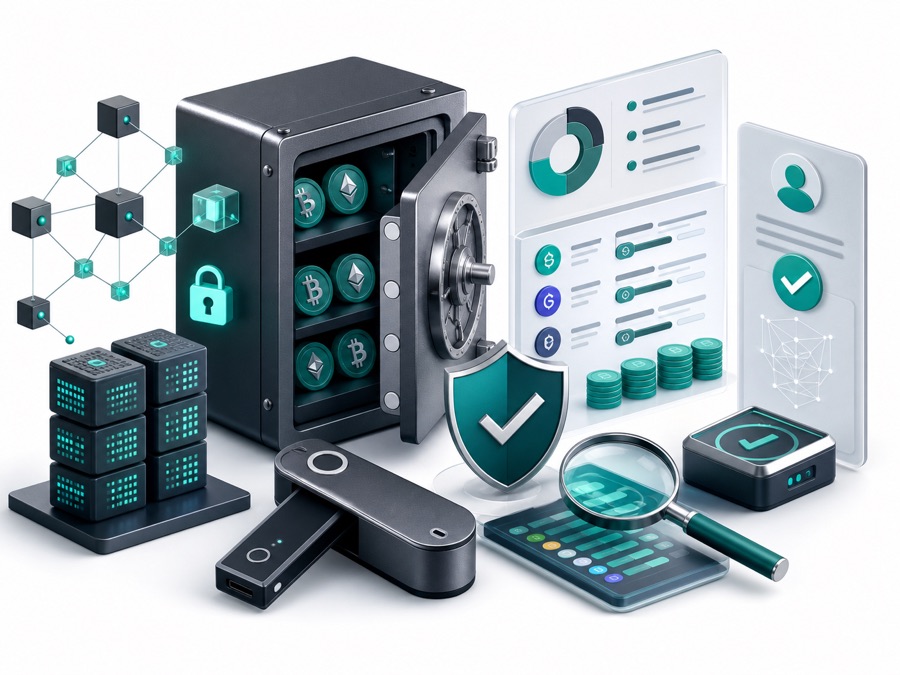
Safety is the most important section of any BitMEX exchange review because derivatives exchanges combine custody risk, market risk, operational risk, and account risk. BitMEX has a strong security narrative: its official pages state that since 2014 the platform has lost zero crypto through intrusion or hacking, that it uses modern custody controls, and that proof-of-reserves and liabilities processes are available. Those are meaningful positives. They do not mean trading on BitMEX is risk-free.
Proof of Reserves and Liabilities
BitMEX says it first published proof of reserves in 2021 and that its proof-of-reserves and liabilities process runs twice a week. The key phrase is "and liabilities." A reserve snapshot alone is less useful if users cannot understand whether customer liabilities are included. A process that lets users verify their account balance within the liability total is more valuable because it speaks to both sides of the solvency picture.
Proof-of-reserves tools should be viewed as a transparency layer, not a guarantee. They can help users check that a platform is making public reserve claims, but they do not eliminate all risks around market structure, legal exposure, internal controls, or future events. The healthiest interpretation is that BitMEX's proof-of-reserves program is a positive signal, especially when paired with a long operating record, but it should be one part of a broader risk assessment.
Custody and Account Security
BitMEX's public institutional page mentions multi-party-computation custody and policy-level transaction controls. Users should still use strong account security: unique password, two-factor authentication, withdrawal address protections if available, dedicated email security, device hygiene, and a low balance policy. Most exchange losses experienced by individuals come from compromised accounts, phishing, poor device security, or overexposure, not only from exchange-level hacks.
Market and Leverage Risk
The largest practical risk for many users is not exchange custody. It is leverage. A platform can operate correctly and a trader can still lose money quickly. High leverage reduces the price movement required to liquidate a position. Volatile crypto markets can move through stops, funding can change, and liquidity can thin at the worst possible moment. Traders should use lower leverage than the maximum available, define risk before entry, avoid adding margin emotionally, and understand the exchange's mark price and liquidation mechanics.
KYC and Account Setup
BitMEX requires identity verification before users can deposit, trade, or withdraw. Its support documentation says there are no unverified tiers. For most individual users, BitMEX lists a government-issued photo ID, a camera-enabled device for a selfie or liveness check, physical location verification or proof of address, and some questions about personal circumstances. The support page says the process is designed to be quick, but real approval time can vary if documents are unclear or if additional review is needed.
Verification Requirements
The account setup flow is designed around verified trading. In practice, users should prepare a valid identity document, a camera-enabled device for the liveness step, and accurate address details. Completing this process before depositing helps keep the first trading session focused on platform setup, order controls and risk settings instead of account administration.
Account Setup Flow
The basic setup flow is simple: create an account, secure it with two-factor authentication, complete verification, test a small deposit, learn the interface, and place only small trades until the order forms, margin display and contract rules are familiar. New users should also read the perpetuals guide, futures guide, fee schedule, funding page, and contract specs before using leverage. This may sound slow, but it is faster than learning through liquidation.
Trading Experience and Platform Usability
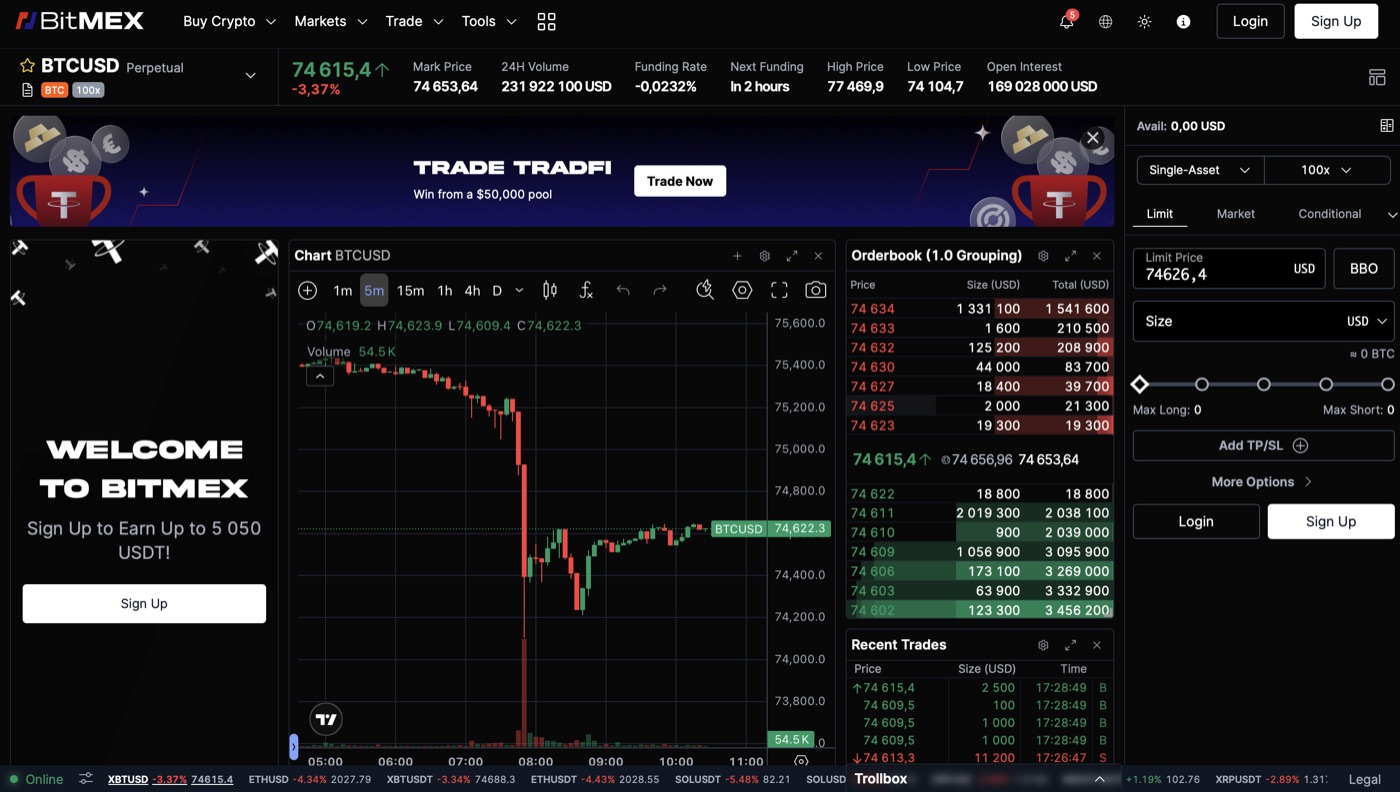
BitMEX's interface is built for traders who want information density. The trading screen typically includes charting, an order book, recent trades, order entry, positions, balances, and contract details. This is efficient once familiar, but it can feel intense compared with a simple buy/sell app. That is not a flaw by itself. It reflects the platform's target user.
Order Types and Risk Controls
Active traders need more than market and limit orders. BitMEX offers advanced order behavior suitable for derivatives trading, including stops and conditional logic. The practical review question is whether a user can express a trade idea clearly and protect downside. Good order controls can help, but they do not guarantee execution at an exact price in a fast market. Slippage, gaps, and liquidity conditions still matter.
The best way to evaluate BitMEX is to use small trades and test the workflow. Place a limit order, cancel it, place a stop, review the margin display, check how the position appears, review realized and unrealized PnL, inspect funding history, and confirm withdrawal behavior. A trader who understands the workflow before sizing up is less likely to make preventable mistakes.
Customer Support and Documentation
BitMEX has a substantial support center and public documentation. That is important because derivatives users need precise answers. The platform includes guides on trading, contracts, verification, fees, and API access. Support quality is difficult to judge universally because it depends on case complexity, verification status, and workload. The more important point for this review is that BitMEX publishes detailed documentation, which gives serious users the material needed to self-verify many claims.
Performance and Reliability
BitMEX markets itself to professional and institutional users with messaging around low latency, liquidity, APIs, and infrastructure. Traders should still monitor the status page, test the platform during active market conditions, and avoid relying on any single exchange for all risk. The crypto market has a history of volatility spikes where even established venues can experience stress. A sensible trader maintains backup plans, avoids overconcentration, and does not keep more collateral on-exchange than needed.
BitMEX Pros and Cons
Pros
- Long operating history dating back to 2014.
- Strong focus on crypto derivatives rather than diluted product sprawl.
- Advanced order book, TradingView-style charting, APIs and professional tooling.
- Public security claims, proof-of-reserves and liabilities, and institutional custody messaging.
- Deep documentation for contracts, funding, fees and trading mechanics.
- Useful for traders who need perps, futures, short exposure and active risk management.
Cons
- Mandatory KYC means there is no unverified trading tier.
- High leverage can create rapid liquidation risk.
- Interface and product structure can be difficult for complete beginners.
- Spot and consumer fiat features are not the platform's strongest reason to sign up.
- Advanced trading tools require careful onboarding and preparation.
BitMEX User Reviews and Experiences
Below is a selection of feedback from BitMEX traders covering execution, liquidity, security, fees, the API and account setup. Submissions are verified against trading activity and moderated before they appear, and ratings reflect each trader's own experience rather than the editorial verdict above.
Based on 14 verified BitMEX user reviews
Withdrawals are boringly reliable
The withdrawal process is so boring and predictable… exactly how it should be. 🚀
Tight spreads and liquidity that holds up
I trade mainly BTC perpetuals on BitMEX and the liquidity is more than sufficient for my needs. Even during low-volatility periods the spread stays tight enough that I can enter and exit positions without feeling like I'm being cheated by the house.
Security-first, and it shows
Security first. 2FA and email confirmations for everything. I feel safe on BitMEX.
100% API uptime for my grid bot
I use the BitMEX API for my grid bot and the uptime has been 100% so far this quarter. The documentation is very clean.
A smooth learning curve if you pace yourself
I started trading on the spot market here before moving to perps. BitMEX has a very smooth learning curve if you take it slow.
No gamification, just a clean trading tool
Love that BitMEX doesn't use those annoying gamification tactics. It's just a clean tool for trading.
Guilds make the quiet hours better
The Guilds feature is a nice touch. It's nice to chat with other BTC traders on BitMEX when the market gets boring.
Fast, professional KYC flow
Verified my BitMEX account really fast and was impressed by the KYC flow. Professional and compliant.
Instant fills, the engine is a beast
Execution speed is insane. I hit market on a BTC long and got filled instantly at the price I wanted. The BitMEX engine is a beast.
BMEX fee discounts are a no-brainer for volume
Using BMEX for the fee discounts. If you do volume on BitMEX it's a total no-brainer.
Sub-accounts ended my spreadsheet mess
Honestly the sub-accounts feature on BitMEX makes managing different strategies so much easier. No more messy spreadsheets.
Still the gold standard for BTC/USD liquidity
I trade mostly BTC/USD and the liquidity on BitMEX is still the gold standard for me.
Came back for the new UI, stayed for the execution
I switched back to BitMEX after a year away and the new UI is much better. Still the same rock-solid execution though.
Clean fills even at 2am
BitMEX order book depth at 2am genuinely surprised me. I threw on a small position just to test, expecting to get wrecked on slippage. Got clean fills every time, and ended up sizing up faster than I originally planned.
Share your BitMEX experience
Traded on BitMEX? Leave a review below. Submissions are moderated before publication.
It's now queued for moderation and will appear here once a member of the team has verified it.
BitMEX Alternatives
The best BitMEX alternative depends on the job. A user who wants simple spot buying may prefer a large consumer exchange with local fiat support. A professional derivatives trader may compare BitMEX with other high-liquidity perpetual venues. A developer may compare API stability and documentation. A compliance-focused institution may care about entity structure, reporting, account management and operational requirements.
When comparing alternatives, do not stop at a table of fees. Check whether your country is supported, whether KYC is required, which assets and contracts are liquid, how withdrawals work, how the exchange handled prior volatility events, whether proof-of-reserves data exists, and how liquidation price is calculated. The best exchange is not always the one with the lowest taker fee. It is the one whose risk model, access rules and product design match your actual trading behavior.
BitMEX Exchange Review FAQ
Is BitMEX legit?
BitMEX is a long-running crypto derivatives exchange founded in 2014 and operated by HDR Global Trading Limited. It has mandatory verification, detailed product documentation, proof-of-reserves visibility and professional trading tools. A fair answer is that BitMEX is a legitimate trading venue built primarily for active derivatives traders rather than a beginner-first retail app.
Is BitMEX safe for beginners?
BitMEX may be too complex for complete beginners. The platform is safer to approach after learning spot trading, margin basics, funding, liquidation and order types. Beginners who still want to test it should use tiny size, avoid high leverage and read the documentation before opening positions.
Does BitMEX have proof of reserves?
Yes. BitMEX says it publishes proof of reserves and liabilities and that the process runs twice a week. Users should treat this as a useful transparency signal, not as a full replacement for personal risk management.
What are BitMEX fees?
Fees vary by product, contract and account tier. BitMEX publishes live fee tables and funding information. Users should check the exact contract they plan to trade because maker, taker, funding and withdrawal costs can differ.
What is the final verdict of this BitMEX exchange review?
BitMEX is a strong, specialized platform for experienced derivatives traders. It is not the simplest exchange and is not suitable for users who do not understand leverage. For the right user, the product depth, operating history, documentation and transparency tools make it worth considering.
Sources Checked for This Review
This review was fact-checked on May 23, 2026 using current public pages. The page intentionally avoids live promises about exact fees or contract counts because those values can change. Before trading, confirm all details on BitMEX directly.
- BitMEX official homepage for product categories, leverage messaging, security claims and platform positioning.
- BitMEX KYC support page for mandatory identity verification.
- BitMEX verification requirements for ID, selfie and location checks.
- BitMEX institutional page for security, custody, proof-of-reserves and API claims.

About the Author
Alex Morgan is an independent crypto markets analyst covering exchange infrastructure, derivatives trading, fee design, and custody risk. Reviews are written from public documentation, hands-on product analysis frameworks, and fact checks against official exchange sources. This article is informational and is not financial advice.